

Learn how marketing analytics drives data-driven success and fuels business growth in the new year. Discover benefits, challenges, comparisons, checklists, schedules, tools, FAQs, and real-world insights.
Quick Overview
- Marketing analytics fuels smarter decisions
- Data replaces guesswork
- Insights improve customer experience
- Growth becomes predictable
- Small businesses gain control
- Consistency beats complexity
Growth Isn’t Guesswork Anymore — It’s Data
There was a time when marketing decisions were made on instinct.
“What feels right.”
“What competitors are doing.”
“What worked last year?”
In 2026, that approach is risky.
Today, businesses that grow consistently don’t guess — they measure.
They don’t assume — they analyze.
They don’t hope — they decide with data.
This is where marketing analytics becomes the most powerful growth partner a business can have.
What Is Marketing Analytics?
Marketing analytics is the practice of collecting, analyzing, and interpreting marketing data to understand what’s working, what’s not, and why.
It helps businesses answer critical questions like:
- Where are customers coming from?
- Which campaigns drive real revenue?
- What content converts best?
- Where should we invest more — or less?
In simple terms:
Marketing analytics turns raw numbers into smart decisions.
Why Marketing Analytics Matters More Than Ever in Recent Years
1. Customers Leave Digital Footprints Everywhere
Websites, emails, ads, social media — every action creates data.
Analytics connects these signals into meaningful insights.
2. Marketing Budgets Demand Accountability
Businesses can no longer afford “hope marketing.”
Analytics shows:
- ROI
- Cost per result
- Revenue impact
3. Competition Is Smarter
Brands using analytics adapt faster — and win faster.
Key Benefits of Marketing Analytics for Business Growth
1. Clear Visibility Into Performance
Analytics removes confusion by showing:
- What’s driving growth
- What’s wasting resources
Clarity leads to confidence.
2. Smarter Resource Allocation
Instead of spreading efforts thin, analytics helps you:
- Invest in high-performing channels
- Cut low-impact activities
Result: More growth with less effort.
3. Improved Customer Understanding
Marketing analytics reveals:
- Customer behavior
- Preferences
- Pain points
This leads to better offers and messaging.
4. Higher Conversion Rates
By tracking performance, businesses can:
- Optimize landing pages
- Improve email timing
- Refine messaging
Small data-driven tweaks = big results.
5. Predictable Growth
When decisions are based on data, growth becomes:
- Repeatable
- Scalable
- Sustainable
How Marketing Analytics Fuels Business Growth
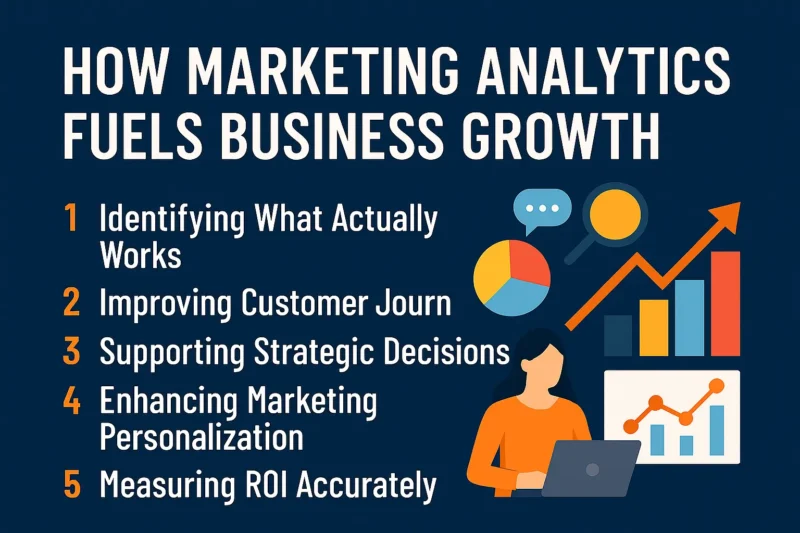
1. Identifying What Actually Works
Analytics highlights:
- Top-performing campaigns
- Best content
- Most profitable channels
No more guessing.
2. Improving Customer Journeys
By analyzing user paths, businesses can:
- Remove friction
- Improve experience
- Increase retention
Happy customers stay longer and spend more.
3. Supporting Strategic Decisions
Data-backed insights guide:
- Product launches
- Pricing strategies
- Market expansion
Analytics aligns marketing with business goals.
4. Enhancing Marketing Personalization
Analytics enables:
- Segmented campaigns
- Targeted messaging
- Personalized offers
Customers feel understood — not sold to.
5. Measuring ROI Accurately
Marketing analytics links actions to outcomes:
- Clicks → Leads → Sales
This transparency builds trust internally and externally.
Core Types of Marketing Analytics You Should Track
1. Descriptive Analytics
What happened?
- Traffic
- Engagement
- Conversions
2. Diagnostic Analytics
Why did it happen?
- Drop-off points
- Low-performing content
3. Predictive Analytics
What will likely happen?
- Sales forecasts
- Trend predictions
4. Prescriptive Analytics
What should we do next?
- Budget recommendations
- Optimization actions
Challenges of Using Marketing Analytics (And How to Solve Them)
Challenge 1: Data Overload
Too much data causes paralysis.
Solution:
Focus on key metrics tied to goals.
Challenge 2: Misinterpreting Data
Wrong conclusions lead to wrong actions.
Solution:
Combine data with context and testing.
Challenge 3: Tool Complexity
Analytics tools can feel intimidating.
Solution:
Start simple and grow gradually.
Challenge 4: Lack of Consistency
Irregular tracking leads to blind spots.
Solution:
Create a routine analytics schedule.
Traditional Marketing Decisions vs Data-Driven Marketing
| Aspect | Traditional Marketing | Data-Driven Marketing |
| Decisions | Based on assumptions | Based on evidence |
| Measurement | Limited | Precise |
| Optimization | Slow | Continuous |
| ROI Tracking | Unclear | Transparent |
| Scalability | Difficult | Efficient |
Data-driven success is no longer optional — it’s essential.
Metrics That Matter Now
- Website traffic quality
- Conversion rate
- Customer acquisition cost (CAC)
- Customer lifetime value (CLV)
- Engagement rate
- Email open & click rates
- Revenue per channel
Track what impacts growth — not vanity metrics.
Ready-to-Use Checklist
- Define business goals
- Select relevant KPIs
- Set up analytics tools
- Track data weekly
- Analyze trends monthly
- Test improvements
- Document insights
This checklist keeps analytics actionable, not overwhelming.
Simple Weekly Schedule
Monday
- Review traffic & performance (20 min)
Wednesday
- Analyze campaign results (20 min)
Friday
- Note insights & plan improvements (20 min)
Total time: 1–1.5 hours per week
Small effort, massive clarity.
Top Marketing Analytics Tools
- Google Analytics 4
- Google Search Console
- HubSpot Analytics
- Hotjar
- Looker Studio
- Mixpanel
You don’t need all — just the right ones.
FAQs
Q. What is the main purpose of marketing analytics?
To understand performance, improve decisions, and drive business growth.
Q. Is marketing analytics only for large businesses?
No. Small businesses benefit the most because data prevents wasted effort.
Q. How often should I analyze marketing data?
Weekly reviews and monthly deep analysis work best.
Q. What’s the biggest mistake in marketing analytics?
Tracking too many metrics without clear goals.
Q. Can analytics improve customer retention?
Yes. It helps identify behavior patterns and engagement gaps.
Q. Do I need technical skills to use analytics?
Basic understanding is enough — tools are becoming more user-friendly.
Conclusion: Growth Follows Clarity
Data doesn’t replace creativity — it guides it.
When businesses embrace marketing analytics, they stop chasing trends and start building systems that grow steadily and confidently.
In the new era, success belongs to brands that:
- Measure intentionally
- Learn continuously
- Act decisively
Because growth isn’t about doing more — it’s about doing what works, backed by data.
Read more articles on Digital Marketing.