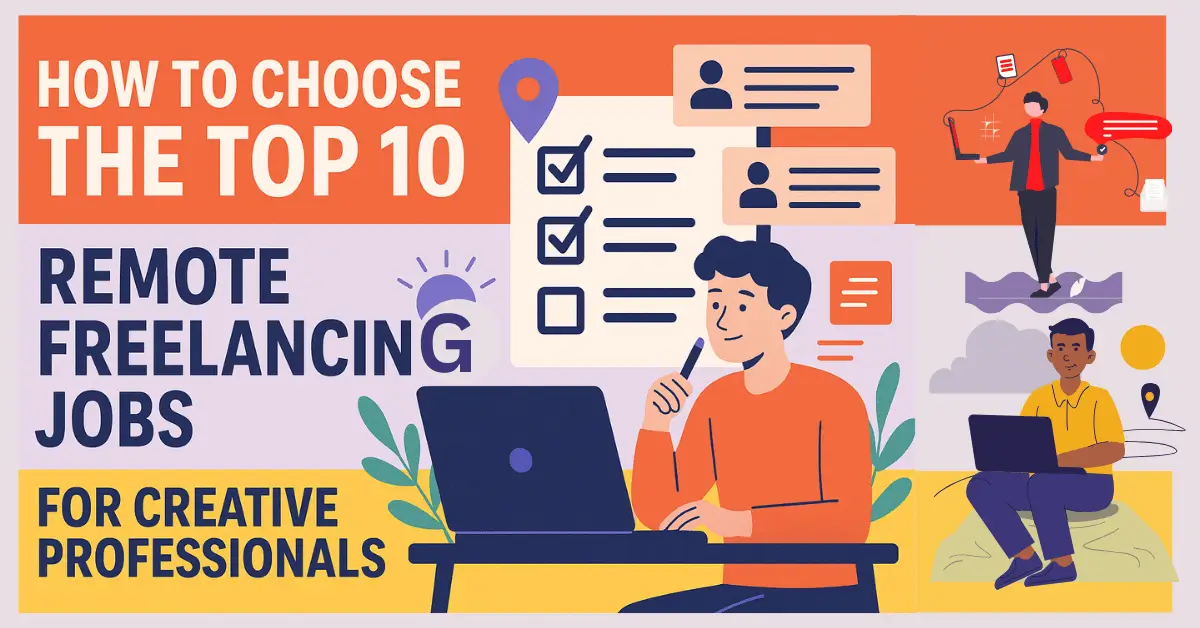
Looking for remote freelancing jobs that fit your creative skills? Discover the top 10 high-paying, flexible gigs for designers, writers, developers, and more—plus expert tips to land your first client and build a thriving freelance career from anywhere. Start today!
Ever felt stuck in a 9-to-5 grind, dreaming of a career that lets you work from anywhere—be it a cosy café in Bali or your home office with a view?
The good news? Freelancing is booming, and creative professionals like you are in high demand. But with so many options, how do you pick the right remote freelancing job—one that pays well, fuels your passion, and fits your lifestyle?
If you’ve ever scrolled through job boards feeling overwhelmed, this guide is for you. We’ll break down the top 10 remote freelancing jobs for creatives, how to choose the best fit, and actionable steps to land your first (or next) gig—without the burnout.
Short Summary Box
What’s Inside?
- Clear definition of remote freelancing for creatives
- Top 10 high-paying, flexible remote freelancing jobs (with salary ranges & demand)
- Key benefits of freelancing (beyond just “being your own boss”)
- Step-by-step strategies to pick the right niche
- Real-life examples of creatives who made it work
- Common mistakes to avoid (so you don’t waste time or money)
- 5-step action plan to launch your freelance career
- Practical checklist to stay organized
Who Is This For?
- Graphic designers, writers, marketers, and artists are tired of traditional jobs.
- Side hustlers looking to go full-time.
- Career changers who want flexibility and creative freedom
- Anyone who’s ever thought, “I wish I could work on my own terms.”
What Is Remote Freelancing for Creative Professionals?
Remote freelancing means working independently for clients or companies from anywhere in the world, without being tied to a physical office. What remote freelancing jobs for creatives, this could mean:
- Writing blog posts from a beach in Thailand
- Designing logos for a startup in Silicon Valley while sipping coffee in Berlin
- Editing videos for a YouTube channel from your home studio
Unlike traditional employment, freelancing gives you:
✔ Control over your schedule (no more 9-to-5)
✔ The freedom to choose projects (no soul-crushing corporate work)
✔ Unlimited earning potential (the more you hustle, the more you earn)
✔ Global opportunities (clients aren’t limited by location)
But here’s the catch: Not all remote freelancing jobs are created equal. Some pay peanuts, some require 24/7 availability, and others demand skills you may not have (yet). That’s why choosing the right niche is crucial.
Why Remote Freelancing Jobs are a Game-Changer for Creatives
The Biggest Benefits of Remote Freelancing Jobs
Financial Freedom (Earn More Than a 9-to-5)
- No salary cap. Unlike traditional jobs, your income isn’t limited by a paycheck. The more clients you land, the more you earn.
- Multiple income streams. You can take on different projects (e.g., writing and social media management) to diversify earnings.
- Higher rates for specialized skills. A senior UX designer can charge $100+/hour, while a beginner writer might start at $0.10/word—but both can scale.
Personal Insight: When I first started freelancing, I was charging $20/hour for graphic design. Within a year, I tripled my rates by niching down (branding for e-commerce stores) and building a portfolio. Specialization = higher pay.
Time Freedom (Work When You Want)
- No commute. That’s 5–10 hours/week saved (and less stress).
- Flexible hours. Night owl? Work at 2 AM. Early bird? Finish by noon.
- Take breaks when needed. Burnout is real—freelancing lets you pause when life gets crazy.
Real-Life Example: Sarah, a freelance illustrator, works only 20 hours/week but earns $6,000/month by focusing on high-paying clients (book covers, merch designs). She spends the rest of her time travelling.
Creative Control (No More “Corporate BS”)
- Choose projects you love. Hate writing about finance? Don’t take those gigs.
- Work with brands you believe in. Want to help sustainable startups? You can.
- Experiment with styles. A graphic designer can switch between minimalist and retro styles based on client needs.
Observation: I’ve seen too many creatives burn out in corporate jobs because they’re forced to follow rigid brand guidelines. Freelancing lets you stay true to your artistic vision.
Global Opportunities (Work with Anyone, Anywhere)
- No location barriers. A writer in India can work for a tech company in the U.S.
- Diverse clients = diverse experiences. You’ll learn about different industries, cultures, and trends.
- Remote-first companies are hiring. Brands like Shopify, Buffer, and Zapier actively seek freelancers.
Personal Story: My first international client was a German e-commerce brand. Working with them taught me how to adapt my writing style for European audiences—something I never would’ve learned in a local job.
Top 10 Remote Freelancing Jobs for Creative Professionals
| 1. Graphic Design | $25–$150/hr | ⭐⭐⭐⭐⭐ | Visual artists, branding lovers |
| 2. Copywriting | $0.10–$1/word | ⭐⭐⭐⭐⭐ | Wordsmiths, marketers |
| 3. Video Editing | $30–$200/hr | ⭐⭐⭐⭐ | Film buffs, YouTube creators |
| 4. Web Development | $50–$200/hr | ⭐⭐⭐⭐ | Tech-savvy creatives |
| 5. Social Media Management | $15–$100/hr | ⭐⭐⭐⭐ | Trendsetters, community builders |
| 6. UX/UI Design | $50–$200/hr | ⭐⭐⭐⭐ | Problem-solvers, tech lovers |
| 7. Content Writing | $0.05–$0.50/word | ⭐⭐⭐⭐ | Storytellers, researchers |
| 8. Photography | $50–$500/session | ⭐⭐⭐ | Visual storytellers |
| 9. Animation | $50–$300/hr | ⭐⭐⭐ | Motion graphics lovers |
| 10. Voiceover Artistry | $100–$1,000/project | ⭐⭐⭐ | Vocal performers, actors |
Pro Tip: Combine skills for higher pay. A copywriter who understands SEO can charge 2x as much as a general writer. A graphic designer who does branding is more valuable than one who only does logos.
How to Choose the Right Freelance Job for You

5 Strategies to Pick Your Perfect Niche
1. Assess Your Skills (What Are You Actually Good At?)
- Action Steps:
- List 3–5 skills you enjoy and excel at.
- Ask friends/clients: “What do you think I’m best at?”
- Take a free skills assessment (e.g., Coursera’s Career Fit).
Example: If you’re a writer who loves psychology, you could specialize in conversion copywriting (writing that sells).
Mistake to Avoid: Choosing a niche just because it’s “trendy.” If you hate coding, don’t force yourself into web development—even if it pays well.
2. Research Market Demand (Will People Pay for This?)
- Action Steps:
- Check job boards (Upwork, Fiverr, LinkedIn) for demand.
- Look at Google Trends to see if interest is growing.
- Join Facebook groups for freelancers in your niche and see what clients are asking for.
Real-Life Example: Voiceover work is booming thanks to podcasts, audiobooks, and AI-generated voiceovers. A friend of mine started with $50 projects and now earns $5,000/month doing commercials.
Personal Insight: I once spent 3 months learning 3D animation—only to realize most clients wanted 2D motion graphics. Research saves time.
3. Evaluate Your Lifestyle (Does This Fit Your Life?)
- Action Steps:
- Ask: “Do I want project-based work (e.g., designing a logo) or ongoing work (e.g., social media management)?”
- Consider time zones (will you need to work odd hours?).
- Think about income stability (some niches, like writing, have seasonal demand).
Example: If you hate deadlines, avoid news-related writing (where speed matters). If you love variety, social media management (with multiple clients) might be better than long-term web development projects.
Mistake to Avoid: Taking on too many different types of work. A graphic designer who also does video editing and copywriting will struggle to specialize and charge premium rates.
4. Test the Waters (Start Small Before Going All-In)
- Action Steps:
- Take on 1–2 small gigs in your niche (e.g., design a logo for a friend).
- Offer free/discounted work to build a portfolio.
- Ask for testimonials from early clients.
Real-Life Example: Alex, a freelance photographer, started by shooting local bands for free in exchange for portfolio pieces. Within a year, he was booking weddings for $ 1,000 or more each.
Personal Story: When I first started copywriting, I took a $50 gig for a small business. The client loved it, referred me to others, and within 3 months, I was charging $500/project.
5. Plan for Long-Term Growth (Can You Scale This?)
- Action Steps:
- Ask: “Can I automate parts of this work?” (e.g., templates for designers, AI tools for writers).
- Think about upselling (e.g., a logo designer could offer branding packages).
- Consider passive income (e.g., selling Canva templates, stock photos, or e-books).
Example: Jessica, a UX designer, started with $50/hour projects. Now, she sells UI kits on Gumroad and earns $3,000/month passively.
Mistake to Avoid: Sticking to one income stream. If you’re a writer, don’t just rely on client work—self-publish an e-book or start a newsletter.
Practical Checklist: Are You Ready to Freelance?
Skills & Portfolio
- I have 3–5 strong skills in my niche.
- I’ve created a portfolio (even if it’s just personal projects).
- I’ve gathered 2–3 testimonials (from past clients or friends).
Market Research
- I’ve checked job boards to confirm demand.
- I know the average rates in my niche.
- I’ve identified 3–5 ideal clients (e.g., startups, agencies, solopreneurs).
Business Setup
- I have a professional email (e.g., yourname@yourdomain.com).
- I’ve set up payment methods (PayPal, Wise, Stripe).
- I’ve created a simple contract template (use HelloSign or DocuSign).
Mindset & Systems
- I’ve set realistic income goals (e.g., $2,000/month in 3 months).
- I have a time management system (e.g., Trello, Notion, or Google Calendar).
- I’ve planned for taxes & expenses (use QuickBooks or Wave).
Launch Plan
- I’ve picked 1–2 platforms to find clients (e.g., Upwork, LinkedIn, cold email).
- I’ve written a strong bio/LinkedIn profile (highlighting results, not just skills).
- I’ve prepared a pitch template for outreach.
5 Mistakes to Avoid When Choosing a Remote Freelancing Jobs
1. Chasing “Easy Money” (Spoiler: It Doesn’t Exist)
- What happens: You pick a niche because it seems profitable (e.g., “AI writing” is hot right now), but you hate the work.
- How to Avoid: Test before committing. Try a small project in the niche before going all-in.
2. Undervaluing Your Work (The “I’ll Do It for Exposure” Trap)
- What happens: You take low-paying gigs because you’re desperate, then burn out.
- How to Avoid: Set a minimum rate (e.g., “I won’t work for less than $30/hour”) and stick to it.
3. Ignoring Your Strengths (Trying to Be a “Jack of All Trades”)
- What happens: You spread yourself too thin, making it hard to stand out or charge premium rates.
- How to Avoid: Pick 1–2 specialities (e.g., “I’m a branding designer for e-commerce stores“).
4. Not Researching the Competition (Flying Blind)
- What happens: You enter a saturated market (e.g., generic logo design) and struggle to get clients.
- How to Avoid: Find a sub-niche (e.g., “logo design for vegan brands“).
5. Skipping the Business Side (No Contracts, No Invoices, No Plan)
- What happens: You get scammed, underpaid, or overwhelmed because you didn’t set up systems.
- How to Avoid: Use contracts, track income/expenses, and automate invoices.
5-Step Action Plan to Launch Your Freelance Career
Step 1: Pick Your Niche (Today) for Remote Freelancing Jobs
- Action: Choose 1 niche from the top 10 list (or combine 2).
- Example: “I’ll be a copywriter for SaaS startups.”
Step 2: Build a Portfolio (This Week)
- Action: Create 3–5 sample projects (even if they’re fake).
- Tools: Use Canva, Behance, or a simple Google Doc for writing samples.
Step 3: Set Up Your Online Presence (This Weekend)
- Action: Create a LinkedIn profile, personal website, or Upwork profile.
- Pro Tip: Use a professional headshot and write a benefit-driven bio (e.g., “I help SaaS startups increase conversions with high-converting copy“).
Step 4: Land Your First Client (Next 30 Days)
- Action: Apply to 5–10 jobs/day on Upwork, Fiverr, or LinkedIn.
- Cold Email Template:
- “Hi [Name],
I noticed you’re looking for a [job title]. I specialize in [niche] and have helped [similar clients] achieve [result].
Here’s a sample of my work: [link].
Would you be open to a quick call to discuss how I can help?
Best, [Your Name]”
Step 5: Scale & Automate (Ongoing)
- Action: Once you have 3–5 steady clients, focus on:
- Raising rates (increase by 20% every 6 months).
- Outsourcing (hire a VA for admin work).
- Creating passive income (sell templates, courses, or digital products).
Final Thoughts for Remote Freelancing Jobs
Your Creative Freedom Starts Now
Freelancing isn’t just about escaping the 9-to-5—it’s about designing a life where your work fuels your passion, not drains it.
Maybe you’ll write blog posts from a cabin in the woods. Maybe you’ll design logos for global brands while sipping matcha in Tokyo. Or maybe you’ll edit videos for YouTubers from your couch in pajamas.
The best part? You get to choose.
But here’s the truth: It won’t always be easy. There will be slow months, difficult clients, and self-doubt. But if you pick the right niche, stay consistent, and keep learning, you’ll build a career that pays well and fulfills you.
So, what’s your first step?
Call to Action: Your Turn!
1. Pick your niche. Which of the top 10 freelance jobs excites you the most? (Drop a comment below—I’d love to hear!)
2. Take action today. Even if it’s just updating your LinkedIn bio or creating one sample project, start small.
3. Join a community. Freelancing can feel lonely—connect with others in Facebook groups, Reddit (r/freelance), or Slack communities.
4. Bookmark this guide. Come back to the checklist and action plan whenever you feel stuck.
Remember: Every expert was once a beginner. Your first client is out there—go get them.
Which freelance job are you trying first? Let me know in the comments!
Read more articles on Digital Marketing.