A portfolio should do more than display your work. It should help someone understand who you are, what you can do, how you think, and why your work matters.
Whether you are a designer, writer, developer, photographer, marketer, teacher, freelancer, student, or career changer, a thoughtful portfolio can turn a collection of projects into a convincing professional story.
Current career guidance continues to emphasize selecting a small group of strong examples, explaining the context behind each project, and making the portfolio easy to navigate rather than treating it as an archive of everything you have ever created.
The good news is that you do not need dozens of impressive clients or years of experience to create something meaningful. A student can build a portfolio from academic and self-directed projects.
A career changer can demonstrate transferable skills through carefully selected examples.
A freelancer can turn completed client work into case studies, while an experienced professional can use a portfolio to show the thinking and results behind major achievements.
Think of your portfolio as a bridge between what you claim on your resume and the evidence someone can actually see. The following step-by-step process will help you build that bridge with purpose.
What Makes a Portfolio Meaningful?
A meaningful portfolio is selective, relevant, and personal. It does not attempt to impress visitors by throwing twenty, thirty, or fifty projects onto one page.
Instead, it guides the viewer toward a handful of examples that demonstrate your strongest abilities and support the kind of opportunities you want next.
A recent 2026 career-portfolio guide recommends choosing roughly six to ten strong pieces, but the exact number matters less than the quality and relevance of what you present.
The word meaningful is important here. A portfolio becomes meaningful when every major element has a reason for being there. Your introduction should establish your professional direction. Your projects should demonstrate useful skills.
Your descriptions should explain decisions rather than merely announce what you created. Your design should make information easier to understand instead of distracting visitors with unnecessary effects.
Most importantly, the portfolio should make the viewer think, “I understand what this person does, and I can see how they could help me.” That is much more powerful than simply saying, “Here are some things I have made.”
Portfolio vs. Resume
A resume tells people where you have been; a portfolio can show them what you can actually do.
Your resume may say that you have experience in graphic design, content writing, web development, marketing, or project management, but your portfolio can provide the visual, written, or functional evidence behind that statement.
Indeed’s current career guidance describes portfolios as useful because they give employers examples of accomplishments and skills rather than relying entirely on claims in application documents.
That difference changes how you should build your portfolio. Do not simply copy your resume into a prettier website. Instead, use your resume as a starting point and then add evidence, context, personality, and selected stories.
If your resume says you redesigned a website, your portfolio might show the original problem, screenshots of the redesign, your decisions, and measurable improvements.
If you are a writer, instead of listing “SEO writing” as a skill, show several articles and explain the audience, purpose, research approach, and result. Your portfolio should answer the question that naturally follows every resume claim: “Can you show me?”
A Step-by-Step Guide in Crafting a Meaningful Portfolio
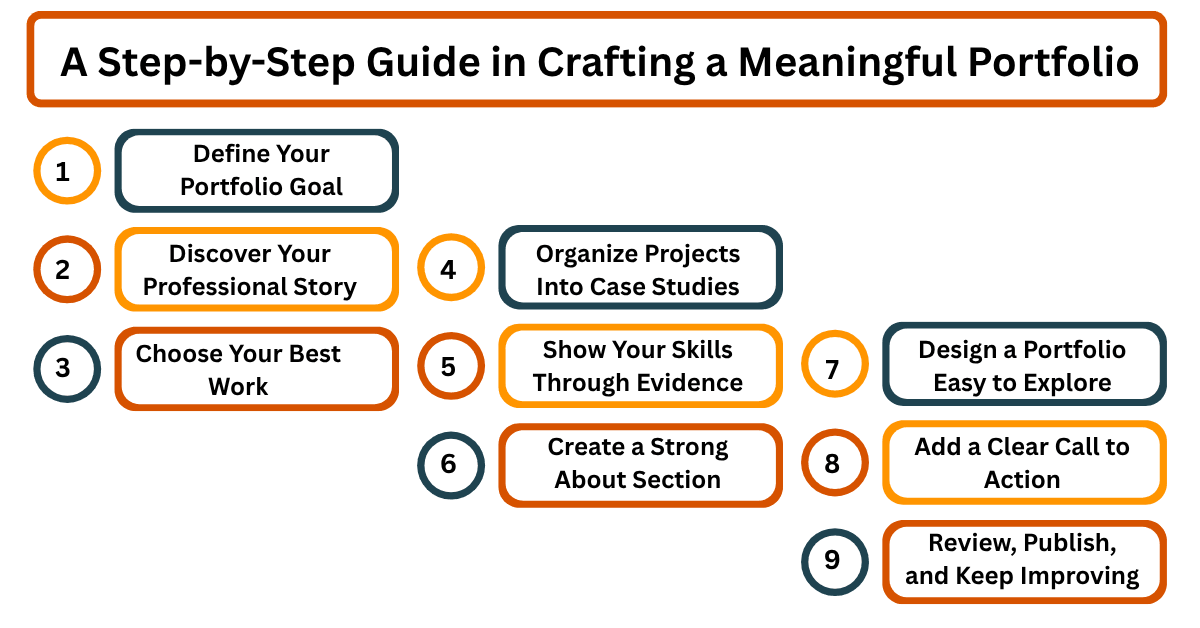
Step 1 — Define Your Portfolio Goal
Before choosing colors, templates, fonts, images, or website platforms, decide exactly what your portfolio needs to accomplish. Are you trying to get a full-time job? Attract freelance clients?
Apply for university? Move into a new industry? Establish yourself as a consultant? Demonstrate creative ability?
A portfolio built for a graphic design agency should not necessarily look like a portfolio designed to attract corporate consulting clients.
The audience and desired outcome should influence everything from the projects you select to the language you use.
Write one simple sentence describing the purpose of your portfolio. For example, “This portfolio will help potential clients understand my ability to create conversion-focused websites,” or “This portfolio will demonstrate my ability to create engaging educational content.”
This sentence becomes your filter. Every time you consider adding something, ask whether it supports that purpose. If it does not, leave it out.
This small discipline prevents one of the most common portfolio problems: trying to appeal to everybody and ending up with something that communicates very little to anyone.
Identify Your Ideal Audience
A portfolio is not really about showing everything you are proud of; it is about showing the right evidence to the right people.
Current portfolio guidance similarly recommends defining who will view the portfolio and what action you want that person to take.
Imagine that a hiring manager has only a few minutes to explore your work. What would they want to know?
A potential client may care about results, reliability, and problem-solving. A creative director may care about originality, craft, and visual thinking.
A recruiter hiring a developer may want to see technical depth, live projects, and links to relevant repositories.
A university admissions reviewer may be interested in growth, experimentation, and your creative process.
Once you understand your audience, your portfolio becomes much easier to edit because you are no longer asking, “What should I include?” You are asking, “What does this person need to see to trust my ability?”
Step 2 — Discover Your Professional Story
Your professional story is the thread connecting your projects. It does not need to be dramatic, and it certainly does not need to sound like a motivational speech.
It simply needs to explain what you care about professionally, what kind of problems you enjoy solving, and what strengths repeatedly appear in your work.
A meaningful portfolio should feel like it belongs to one person rather than looking like a random folder containing unrelated assignments.
Look at your previous projects and search for patterns. Perhaps you repeatedly simplify complicated information. Maybe you enjoy creating clean visual systems.
Perhaps you specialize in helping small businesses communicate online. Maybe your strength is researching difficult subjects and turning them into understandable content. These patterns can become the foundation of your positioning.
Modern portfolio examples increasingly focus on a clear promise and visible proof rather than simply displaying a job title or long list of skills.
Turn Your Experience Into a Narrative
You do not need to tell your entire life story. Instead, connect your experience to the professional direction you want to establish.
For example, a former teacher moving into instructional design could explain how years of creating lessons, adapting material for different learners, and evaluating understanding developed skills relevant to digital learning.
A photographer might explain how an early interest in documentary storytelling developed into a specialization in brand photography. A marketer might connect experience in writing, analytics, and customer research to a focus on content strategy.
This approach is particularly useful for career changers and people with unconventional backgrounds. Your previous experience does not have to disappear simply because you are entering a new field.
Instead, translate it into relevant strengths. A portfolio can become a narrative bridge between your previous career and your future direction.
The goal is not to convince people that your past is irrelevant; it is to help them see how your existing abilities can create value in a new context.
Step 3 — Choose Your Best Work
Now comes the editing stage. Gather your projects in one place and temporarily ignore whether each one is “good enough.”
Put everything on the table: professional work, freelance projects, academic assignments, volunteer work, personal experiments, side projects, mock projects, published articles, designs, websites, presentations, videos, or other relevant evidence. Then start eliminating.
Ask four questions about each project. Is it relevant to the opportunity I want? Does it demonstrate a meaningful skill? Is the quality strong enough to represent me? Can I explain what I contributed?
A project that scores well on all four is a strong candidate. A beautiful project that has nothing to do with your target role may be less useful than a modest project that directly proves an important capability.
Prioritize Quality Over Quantity
Your portfolio is an edited collection, not a storage facility. Six excellent projects can communicate more confidence than thirty mediocre ones. A visitor should not have to dig through endless thumbnails before discovering your strongest work.
Current professional portfolio recommendations similarly emphasize selecting a focused group of strong examples rather than publishing everything.
A useful way to organize your work is to create three groups: must include, maybe include, and remove.
Put your strongest and most relevant projects in the first group. Put projects that provide variety or demonstrate a secondary skill in the second.
Everything else can disappear from the public portfolio without disappearing from your personal archive.
Remember that removing a project is not rejecting your own history. It is simply recognizing that a portfolio has a specific job to perform.
Step 4 — Organize Projects Into Case Studies
A project becomes much more interesting when you explain what happened behind the finished product.
A screenshot by itself may show that you can produce something attractive, but a case study can show how you think.
This is especially important for professionals whose value comes from decision-making, research, strategy, analysis, communication, or problem-solving.
A strong case study does not need to become a ten-page report. Give the reader enough information to understand the situation, your responsibility, the major decisions you made, and the outcome.
Recent portfolio examples commonly structure work around the starting point, the work performed, and the measurable or observable result.
Explain the Problem, Process, and Outcome
A simple framework works extremely well:
- Problem: What needed to be solved?
- Role: What exactly did you do?
- Process: How did you approach the challenge?
- Outcome: What changed because of the work?
- Learning: What did the experience teach you?
Suppose you designed a website for a small business. Do not write only, “I designed a modern responsive website.”
Explain that the old site was difficult to navigate, the client needed clearer service information, and visitors were struggling to find the contact option.
Then show how you reorganized the information architecture, redesigned important pages, improved mobile presentation, and created a clearer path toward contacting the business.
If you have measurable results, include them. If you do not, describe credible outcomes such as improved usability, positive client feedback, faster workflows, or a clearer customer journey. This transforms the project from an image into evidence of professional thinking.
Step 5 — Show Your Skills Through Evidence
A long skills list is easy to write and easy to ignore. “Communication, leadership, creativity, teamwork, problem-solving” sounds acceptable, but almost anyone can write the same words.
Evidence makes those words believable. Instead of merely claiming that you are a strong communicator, show an article you researched and wrote, a presentation you created, a campaign you developed, or a complex concept you explained clearly.
The same principle applies to technical skills. If you list WordPress, HTML, CSS, JavaScript, Photoshop, Figma, Excel, SEO, or another tool, connect the tool to actual work whenever possible.
A visitor should understand what you used the skill to accomplish, not simply which software you know. This approach makes the portfolio more persuasive because the emphasis moves from “I know this tool” to “I can use this tool to solve this type of problem.”
Step 6 — Create a Strong About Section
Your About section should answer three basic questions: Who are you? What do you do? Why should someone care?
It does not need to contain your complete biography. In fact, a short, focused introduction is often more effective than several paragraphs of personal history.
Start with your professional identity and specialty. Then briefly mention relevant experience, strengths, interests, or values that help explain your approach. Finally, connect your background to the people or organizations you want to work with.
You can include a professional photograph if appropriate, along with links to relevant professional networks or credentials. The goal is to make the person behind the projects feel real without turning the page into an autobiography.
A useful About section might say that you are a content strategist who helps health and wellness brands turn complex information into clear, search-friendly articles.
It could mention your background, your research approach, and the types of projects you enjoy. Notice how much stronger that is than simply saying, “I am a passionate content writer.” Specificity gives your identity shape.
Step 7 — Design a Portfolio That Is Easy to Explore
Good portfolio design should make your work easier to understand. It does not need to compete with the work itself. A visually impressive website can actually weaken a portfolio if visitors struggle to find projects, read text, understand navigation, or identify what you do.
Keep the structure predictable. Your homepage can introduce your positioning and highlight selected work.
A Work or Projects section can organize your case studies. An About page can provide background, while a Contact page gives visitors an obvious next step.
For technical professionals, relevant links to GitHub, live builds, or other platforms can strengthen the portfolio, while creatives may need larger visual previews.
Make It Mobile-Friendly and Easy to Scan
Your portfolio should work comfortably on a phone as well as a desktop computer. Check headings, image sizes, buttons, navigation, spacing, and text readability on smaller screens.
A portfolio that looks beautiful on a large monitor but becomes difficult to navigate on mobile creates unnecessary friction.
Scanning matters too. Use descriptive headings, short sections, strong visual hierarchy, and enough whitespace to prevent the page from becoming a wall of text.
You do not need to remove detailed information; simply organize it so that readers can quickly understand the main point and explore deeper when they are interested. A good portfolio respects the visitor’s time.
Step 8 — Add a Clear Call to Action
Never make someone admire your work and then wonder what to do next. Your portfolio needs a clear call to action.
Depending on your goal, that might be “Hire Me,” “Let’s Work Together,” “Request a Quote,” “View My Resume,” “Book a Consultation,” or simply “Get in Touch.”
Place your primary action where visitors can easily find it, particularly near the end of your homepage and project pages. Your contact information should not be hidden behind several unnecessary clicks.
If your goal is employment, you might include a downloadable resume and LinkedIn profile. If your goal is freelancing, make it easy to send an inquiry.
A portfolio is not successful simply because someone visits it; it succeeds when the right visitor takes the next meaningful step.
Step 9 — Review, Publish, and Keep Improving
Your first published portfolio does not have to be your final portfolio. In fact, treating it as a living professional asset is often better than waiting months for perfection.
Publish when the structure is strong, your best projects are represented, your contact information works, and the site is easy to navigate.
Then improve it as you gain better projects, stronger results, testimonials, certifications, or clearer professional positioning.
Before publishing, check every link, image, button, downloadable file, and contact form. Proofread your project descriptions and make sure your strongest work appears early.
Ask someone unfamiliar with your work to browse the site and explain what they think you do after a few minutes. If their answer is completely different from your intended positioning, that is useful feedback.
Finally, remember that a portfolio is not a monument to your past. It is a tool for your future. As your career changes, your portfolio should change with it.
Remove outdated projects, replace weak examples, improve case studies, and add work that supports your next professional goal.
This ongoing editing process keeps the portfolio relevant and prevents it from becoming a digital museum of work you no longer want to be known for.
FAQs
Q. How many projects should a portfolio have?
There is no universal number, but a focused collection of around six to ten strong projects can provide enough evidence without overwhelming visitors.
The ideal number depends on your profession and experience. Choose projects based on relevance, quality, variety, and your ability to explain your contribution rather than trying to reach an arbitrary target.
Q. Can I create a portfolio without professional experience?
Yes. Students, beginners, and career changers can use academic assignments, volunteer projects, personal experiments, mock projects, and self-directed work.
The key is to make the context clear and demonstrate relevant skills. A well-explained personal project can provide stronger evidence of your ability than an unrelated professional project.
Q. Should my portfolio include every project I have completed?
No. Your portfolio should be curated rather than exhaustive. Keep a private archive of your complete work history, but publicly display projects that support your current professional direction. Removing irrelevant or weaker work can actually make your strongest work more convincing.
Q. Do I need a website for my portfolio?
Not necessarily. A portfolio can exist as a PDF, presentation, specialized platform profile, repository, or personal website depending on your profession.
However, a website can provide greater control over your personal brand, navigation, case studies, and contact experience. The best format is the one that allows your target audience to understand and evaluate your work easily.
Q. How often should I update my portfolio?
Review it whenever you complete significant new work or your career direction changes.
A deeper review every few months can help you remove outdated projects, improve descriptions, replace weak examples, and make sure the portfolio still supports your current goals. Your portfolio should grow with your career rather than remain frozen in time.
Conclusion
A meaningful portfolio is built through clarity, selection, storytelling, evidence, and continuous improvement.
You do not need to overwhelm visitors with hundreds of projects or create an elaborate website packed with animations. You need to make your strongest work easy to find and easy to understand.
Start by defining your goal and identifying your audience. Then select projects that demonstrate the skills you want to be hired for, turn the strongest examples into case studies, explain the thinking behind your decisions, and show outcomes whenever possible.
Add a focused About section, create simple navigation, make the experience mobile-friendly, and give visitors a clear way to contact you.
The most important shift is to stop thinking of your portfolio as a collection of things you have done. Think of it as a carefully constructed argument: this is who I am, this is the kind of problem I solve, this is how I approach it, and here is the evidence that I can do it well.
When every element supports that argument, your portfolio becomes more than a showcase. It becomes a professional asset that can open doors.
Need a Professional Portfolio That Stands Out?
Get expert help with portfolio writing, website design, SEO content, and professional copywriting tailored to your goals.
Contact me today to turn your skills and experience into a portfolio that attracts the right opportunities.
Read more articles about Online Earning