

Learn how to master featured snippets in Google Search with practical SEO strategies, keyword research, content optimization, and real examples.
Why Featured Snippets Matter in SEO
Have you ever searched for something on Google and noticed a box displaying a direct answer above the regular search results?
Perhaps you searched for “how to improve website speed” or “what is keyword research” and immediately found a short explanation without opening a website.
That special search result is called a featured snippet.

For website owners, bloggers, and digital marketers, featured snippets represent an opportunity to gain additional visibility in Google Search. Instead of appearing only as a traditional search listing, your content may be selected to answer a user’s question directly.
Imagine someone searching for “how to write an SEO-friendly blog post.” If Google selects a helpful section from your article, your website could appear in a prominent position where searchers can quickly see your answer.

However, getting a featured snippet is not simply about adding keywords or writing a short paragraph. You need to understand search intent, organize your content, answer questions clearly, and provide genuinely useful information.
In this guide, you will learn how featured snippets work, how to identify opportunities, and how to optimize your existing and new blog posts to improve their chances of appearing in these prominent search results.
What Are Featured Snippets in Google Search?
Featured snippets are carefully chosen passages from websites that Google prominently displays in search results to give users an instant response to their queries.
They usually appear near the top of Google’s search results, although their exact placement can vary. They may also appear within related question sections.
Unlike ordinary search listings, featured snippets display a portion of a webpage’s content before the user clicks through to the website.
For example, imagine searching:
“What is email marketing?”
Google might display a short definition from a marketing website, followed by the webpage title and link.
The purpose is straightforward: help people find useful information quickly.
Featured snippets are particularly relevant for informational searches, including:
- What is search engine optimization?
- How does email marketing work?
- How to create a website?
- What are the benefits of content marketing?
- How many words should a blog post contain?
Being included in a highlighted snippet can boost brand awareness and build trust for website owners. However, since some people might find the solution without clicking, it does not ensure increased website traffic.
It is also important to understand that Google automatically selects featured snippets. Website owners cannot manually submit a page or request a guaranteed placement.
Why Are Featured Snippets Important for SEO?
In competitive search results, featured snippets might make your website stand out. Google may choose to display your material more prominently than regular listings if it offers a helpful response.
Here are five important benefits.
A. Greater Search Visibility
Featured snippets can place your content in a prominent location, making your website more noticeable to potential visitors.
This is particularly useful for smaller websites competing with established domains.
B. Improved Brand Recognition
Even when users do not immediately click your website, seeing your brand associated with a helpful answer can increase familiarity and recognition.
C. Opportunities to Attract Organic Traffic
A relevant snippet can encourage users to visit your website for additional information, examples, instructions, or resources.
However, traffic results vary. Some featured snippets answer questions completely, while others encourage users to explore the original article.
D. Better Content Organization
Optimizing content for featured snippets encourages you to write clear definitions, organize information under meaningful headings, and answer common questions directly.
These improvements can also make your articles easier for readers to navigate.
E. Stronger Topical Coverage
When you address related questions within an article, you provide readers with a more complete understanding of the subject.
This can help establish your website as a useful resource within its topic area.
Remember: Featured snippets are an SEO opportunity, not a guaranteed ranking advantage. Focus on creating helpful content rather than trying to manipulate Google’s selection process.
What Are the Different Types of Featured Snippets?
Before optimizing your website, understand the main formats Google can display.
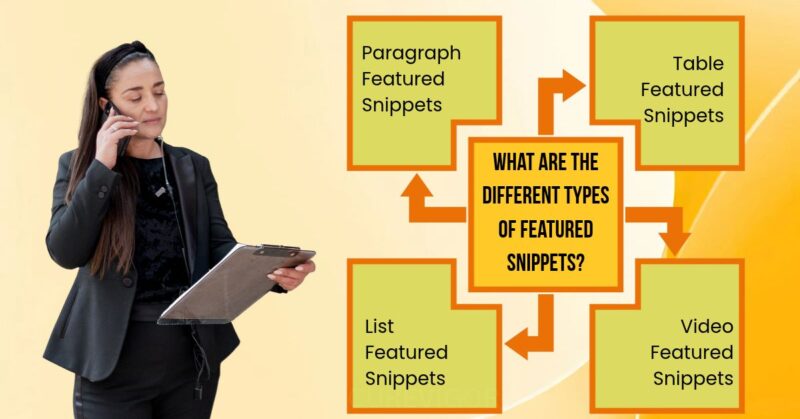
1. Paragraph Featured Snippets
Paragraph snippets display a short text-based answer to a search query.
For example:
Search query: What is keyword research?
Sample answer:
Finding the terms and phrases people use in search engines is known as keyword research. It aids website owners in comprehending search demand and producing material that appeals to their target market.
This format works well for definitions, explanations, and straightforward questions.
2. List Featured Snippets
List snippets display information in an ordered or unordered format.
They are particularly useful for:
- Step-by-step instructions.
- Top recommendations.
- Benefits and disadvantages.
- Checklists.
- Tutorials.
For instance, a numbered list outlining the key steps may be included in an article titled “How to Start a Blog.”
3. Table Featured Snippets
Table snippets present information in rows and columns.
They are useful for comparisons, pricing information, specifications, and structured data.
For example, an article comparing free and paid SEO tools could include a table showing their features and intended users.
4. Video Featured Snippets
Google may also display video results that highlight a relevant moment in a video.
These results are useful for tutorials, demonstrations, product instructions, and educational content.
If you publish instructional videos, provide descriptive titles, useful descriptions, and properly structured video information.
How Does Google Select Featured Snippets?
Google automatically identifies content that it considers useful for answering a particular search query.
Its systems evaluate webpages and determine which information may best satisfy the user’s search intent.
Google does not provide a fixed formula for featured snippet selection.
However, several content practices can improve the usefulness and accessibility of your pages.
Clear answers: Explain the subject directly instead of making readers search through several paragraphs.
Relevant headings: Use descriptive H2 and H3 headings that accurately represent the information below them.
Useful formatting: Present instructions as lists, comparisons as tables, and definitions as concise paragraphs.
Reliable information: Check facts, support important claims with trustworthy references, and keep information current.
Relevant content: Make sure the page addresses the actual question instead of repeating keywords without adding value.
Google also emphasizes helpful, reliable, people-first content rather than pages created primarily to manipulate search rankings.
There is no guaranteed word count, paragraph length, or special formatting technique that automatically earns a featured snippet.
How to Find Featured Snippet Opportunities
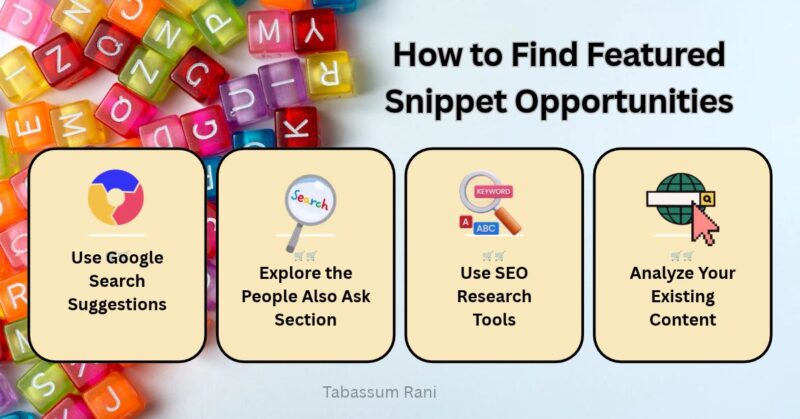
One of the most important steps is identifying keywords and questions that already trigger featured snippets.
Instead of choosing random keywords, look for searches where Google displays a direct answer.
Here are some practical methods.
A. Use Google Search Suggestions
Start by entering your main keyword into Google.
For example, type:
- How to improve website SEO
- What is digital marketing?
- How does email marketing work
- Best ways to increase website traffic
Pay attention to Google’s autocomplete suggestions and related questions.
These can provide ideas for informational content and supporting headings.
B. Explore the People Also Ask Section
Google’s People Also Ask section displays related questions that searchers may find useful.
For example, if your main topic is SEO, you might find questions such as:
- What are the four types of SEO?
- How long does SEO take?
- Can beginners learn SEO?
- What is the difference between SEO and SEM?
Use relevant questions to identify content gaps and build helpful FAQ sections.
Remember that People Also Ask results and featured snippets are different search features, even though they can appear together.
C. Use SEO Research Tools
Several SEO platforms can help identify keyword opportunities and track search visibility.
Examples include:
- Google Search Console
- Ahrefs
- Semrush
- Ubersuggest
- SE Ranking
Some paid SEO platforms provide reports identifying keywords for which featured snippets appear and whether a particular website owns the snippet.
If you have a limited budget, begin with Google Search Console and manual Google searches.
D. Analyze Your Existing Content
Do not always create a new article.
Sometimes, an existing page already ranks for relevant informational queries but does not provide a clear answer near the appropriate heading.
Review your existing articles and identify opportunities to improve their structure, explanations, and formatting.
This can be a practical starting point for smaller websites.
How You Optimize Your Content for Featured Snippets
Once you identify suitable keywords, the next step is to optimize your content.
You do not need to rewrite every article. Start by improving the sections that directly answer relevant search queries.
A. Answer the Main Question Immediately
If your heading asks a question, provide a direct answer in the first paragraph below it.
For example:
What Is On-Page SEO?
Optimizing individual website pages to increase their search engine visibility is known as “on-page SEO.” It includes improving titles, headings, content, internal links, images, and other page elements.
After providing the definition, explain the topic in more detail.
This approach helps readers find answers quickly and makes your content easier to understand.
B. Use Question-Based Headings
Think about how people search online.
Instead of using a heading such as:
“Benefits of SEO”
You could write:
“What Are SEO’s Principal Advantages for Small Businesses?”
Both headings can work, but the second one directly addresses a question.
Use natural variations rather than forcing every heading to contain an exact keyword.
C. Keep Answers Clear and Concise
Avoid unnecessary introductions before answering a question.
For example, if someone searches “How many types of SEO are there?” do not begin with several paragraphs about the history of search engines.
Provide the answer first, then explain each type.
There is no official paragraph length that guarantees a featured snippet. Write enough to answer the question completely without unnecessary repetition.
D. Use Lists and Tables
If your article explains a process, use numbered steps.
If you compare products, services, or methods, consider using a table.
Good formatting makes information easier for readers to scan and understand.
E. Add Relevant Images
Images can help explain complicated processes and make your content more engaging.
Use descriptive image filenames and meaningful alternative text.
For example:
featured-snippet-optimization-guide.jpg
Alt text:
“Example of a featured snippet appearing in Google Search.”
Make sure the description accurately represents the image.
How to Use Keyword Research for Featured Snippets
Keyword research is an important part of featured snippet optimization.
However, finding a keyword with high search volume is not enough. You should understand what users actually want when they enter that search term.
Consider these three types of searches:
| Search intent | Example keyword | Suitable content |
| Informational | What is technical SEO? | Definition and explanation |
| Instructional | How to improve website speed? | Step-by-step guide |
| Comparative | SEO vs. SEM | Comparison table |
For better results, create a list of questions related to your primary keyword.
For instance, if “email marketing” is your primary keyword, some examples of supporting queries are:
- What is email marketing?
- How does email marketing work?
- What are the benefits of email marketing?
- How often should businesses send marketing emails?
- Which email marketing tools are best for beginners?
You can use these questions as H2 or H3 headings where they fit naturally.
My recommendation: Start with long-tail keywords. They often express a more specific search intent and can help smaller websites target focused topics.

Common Featured Snippet Optimization Mistakes
Many website owners make avoidable mistakes when trying to appear in featured snippets.
Here are some practices to avoid.
1. Writing for search engines instead of readers
Do not fill your paragraphs with repeated keywords. Write naturally and answer questions properly.
2. Using vague headings
Headings such as “More Information” or “Other Things” do not clearly communicate what a section explains.
Use descriptive headings instead.
3. Providing incomplete answers
A short answer is useful only when it actually answers the question. Do not remove important context to make a paragraph shorter.
4. Ignoring search intent
If someone searches for a tutorial, they probably want instructions rather than a general definition.
Match your content to the purpose of the search.
5. Publishing unverified information
Incorrect statistics, outdated recommendations, and unsupported claims can damage reader trust.
Check your information before publishing.
6. Expecting immediate results
Featured snippets are selected automatically. Even well-optimized pages may not receive them.
Continue improving your content and monitoring performance rather than expecting instant results.
How to Track Featured Snippet Performance
SEO optimization does not end when you publish an article.
You need to monitor how your content performs and identify areas for improvement.
Use Google Search Console
A free tool called Google Search Console assists website owners in understanding how their pages rank in Google Search.
You can use it to examine:
- Search queries bringing impressions.
- Total clicks.
- Average click-through rate.
- Average search position.
- Pages receiving search visibility.
For example, if an article receives impressions for several question-based searches but has a low click-through rate, review its title and search presentation.
One important limitation: Google Search Console does not provide a dedicated report showing every featured snippet your website owns.
You can combine Search Console data with manual Google searches and third-party SEO tracking tools to investigate snippet opportunities.
Monitor Your Target Keywords
Create a simple spreadsheet containing:
| Keyword | Target page | Current position | Featured snippet |
| What is keyword research? | SEO Guide | Check GSC | Not verified |
| How to improve SEO? | SEO Tips | Check GSC | Not verified |
| What is content marketing? | Marketing Guide | Check GSC | Not verified |
Update the spreadsheet periodically.
Search results can change depending on the search query, location, device, and time. Therefore, treat manual checks as observations rather than permanent ranking measurements.
Practical Example: Optimizing a Blog Post for Featured Snippets
Imagine you run a small digital marketing blog and publish an article titled “How to Improve Website SEO.”
Your article contains useful information, but the introduction is long, and the main question is not answered directly.
You decide to improve its structure.
Original heading:
SEO Strategies for Your Website
Improved heading:
What Are the Best Ways to Improve Website SEO?
You then add a direct answer:
The best ways to improve website SEO include creating helpful content, targeting relevant keywords, improving page titles, optimizing website speed, building internal links, and ensuring a good mobile experience.
Next, you explain each recommendation in a separate section.
You also add a numbered list:
- Research relevant keywords.
- Write useful and original content.
- Optimize title tags and meta descriptions.
- Improve internal linking.
- Compress images and improve loading performance.
- Make your website mobile-friendly.
- Monitor performance using Google Search Console.
Finally, you review the entire article for accuracy, remove unnecessary repetition, and add relevant internal links.
What is the expected result?
Your article becomes easier to read, more organized, and more useful for people searching for SEO advice.
It may become a stronger candidate for relevant search features, including featured snippets. However, Google makes the final selection, and there is no guarantee of placement.
This example demonstrates why content improvements should focus on answering questions rather than simply inserting keywords.
Final Checklist Before Publishing Your Article
Use this checklist when preparing a blog post that targets featured snippet opportunities.
- Identify the primary keyword and related questions.
- Understand the search intent.
- Write a clear answer beneath relevant question-based headings.
- Use descriptive H2 and H3 headings.
- Organize instructions into numbered lists.
- Use tables for relevant comparisons.
- Add useful examples and explanations.
- Include relevant internal links.
- Link to trustworthy external references.
- Optimize images and alternative text.
- Check grammar, accuracy, and readability.
- Review the page on mobile devices.
- Submit or inspect the URL in Google Search Console.
Remember that these are content quality and SEO practices, not a guaranteed featured snippet formula.
Conclusion: Make Your Content Worth Featuring
Mastering featured snippets in Google Search is not about finding a secret SEO trick. It is about understanding what people search for and providing clear, accurate, and useful answers.
Start by identifying question-based keywords. Organize your content with meaningful headings, concise explanations, lists, and tables. Improve existing articles where necessary, and monitor your search performance regularly.
Most importantly, do not forget the people behind every search query.
Your goal should not simply be to appear at the top of Google. Your goal should be to provide an answer that genuinely helps someone solve a problem or understand a subject.
When you consistently create valuable content, you give your website better opportunities to earn search visibility and build long-term credibility.
FAQs
Q. What is a featured snippet in Google Search?
A chosen passage from a webpage that Google prominently displays in search results to address a user’s query is known as a featured snippet. It may appear as a paragraph, list, table, or video result.
Q. How can I get my website featured in Google Search snippets?
Create helpful content that directly answers relevant questions. Use descriptive headings, clear paragraphs, numbered lists, and tables where appropriate. Make sure your information is accurate and relevant to the search query. Google automatically selects featured snippets, so placement cannot be guaranteed.
Q. Do featured snippets improve website traffic?
Featured snippets can increase search visibility and brand recognition. They may attract visitors who want additional information. However, some users may find their answers directly in the search result without clicking, so traffic improvements are not guaranteed.
Q. Does schema markup help websites get featured snippets?
No specific schema markup is required to qualify for featured snippets. Google selects suitable content automatically. Structured data can help Google understand certain types of page content and support eligible search appearances, but it does not guarantee featured snippet placement.
Q. How long does it take to get a featured snippet?
There is no fixed timeline. Google may select content after crawling and evaluating a page, but it does not guarantee that an optimized article will receive a featured snippet. Results depend on Google’s systems, the search query, competition, and content relevance.
Trusted References and Further Reading
- Google Search Central – Featured Snippets and Your Website
- Google Search Central – SEO Starter Guide
- Google Search Central – Creating Helpful, Reliable, People-First Content
- Google Search Central – Control Your Search Snippets
Read more articles on Digital Marketing